


The “Nushia” lost in translation
Have you ever read that when Imu speaks, they use “Nushia”? Have you been told it means “the master” or “your lord”? That this “Nushia” exists as a separate being within Imu?
Today we’re here to debunk most of those claims. I’ve analyzed EVERY sentence by/to/about Imu. In this article I’m going to explain why “Nushia” CANNOT be a word Imu uses to refer to themselves. They use it to refer to the person they’re speaking to. Shall we begin?
The common mistake
 First, let’s address the most important thing. This isn’t about calling anyone out. What happened here is a very common mistake. The word Oda uses here (as almost always with characters like this) is deliberately obscure. That’s why it’s NORMAL to have misread it if the specific context wasn’t taken into account.
What usually happens with these types of characters is that the context doesn’t come complete the first time we see them, it’s only later that we can fully understand it and correct our reading retroactively. I also think it’s our duty to point it out when we notice it, so others can understand it too.
 As an example, many people didn’t notice that Kiku used “Sessha” as a first-person pronoun. Some translators omitted this because “it was normal in old Japanese.” But the key detail was that “Sessha” is used by male samurai. This is what made Zoro suspect something was going on there.
As I was saying, this mistake is more than understandable. It immediately catches our attention that Imu would use “the master orders you to…”. That fits someone like Imu perfectly, the ruler of the One Piece world with unmatched arrogance. Just as many people interpret “Mu” as third person, Imu referring to themselves. “Nushia” invites the same reading.
The word “Nushia” (ヌシア)
“Nushia” is written in Katakana (just like “Mu”). This sets it apart slightly from “pure Japanese” text, as Katakana is typically used for foreign words or terms that “don’t quite fit” in a given context.
Oda is telling us that this word “is not standard Japanese,” that what we’re reading “is not something normal.”
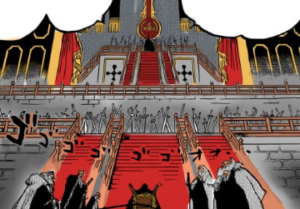 In modern Japanese it’s very tempting to read “Nushia” (ヌシア) as “master” or “owner,” because even though “Nushia” doesn’t exist in Japanese, “Nushi” (主/ぬし) does. If you look it up, you’ll find those meanings are among the first results in virtually any modern dictionary.
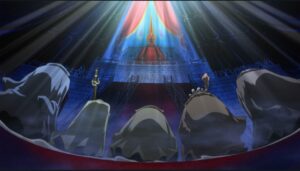
As I said, the first time Imu used it, it led us toward that reading. Not only because “Nushi” (主/ぬし) is a real word, but because we saw Imu at the top of the Empty Throne looking down with arrogance at a “mere human,” Cobra. All of this while Imu carefully and arrogantly decided which of the Arabasta king’s questions were worth answering.
Saying “the master” in that moment is far more impactful and fitting for the atmosphere Oda has built atop Mary Geoise. And as I mentioned, it’s nothing new or unusual to see someone with a superiority complex refer to themselves in the third person.
As an extra note, this is also why many people at the time believed Imu was a child, since in countless anime and manga dialogues children say their own name instead of “I” (or simply omit the subject entirely).
All of this changes when we have more context, like we do now, where none of these readings hold up once you look at every use of “Nushia” together.
After this “brief” introduction, let’s get into the actual explanation.
How is “Nushia” (ヌシア) used?
 Now that we understand “Nushia” (ヌシア) could be read as “the master” or something similar, we just need to look at the original text with that in mind, checking that it always points to the same subject: Imu. Once we do, we’re left puzzled (at least I was) to find that it never, without exception, points to Imu. “Nushia” points to different people with each use.
“Nushia” can only fit into one grammatical category, one that changes its reference depending on who is standing before Imu. The 2nd person. Imu uses it with people like Cobra, Rocks, Brook, Loki and Luffy, among others.
Throughout Imu’s speeches we can confirm this through the particles that accompany it. “Nushia” appears alongside “が, を, の, は, ら/達”. This screams that we’re dealing with a personal pronoun in Japanese, not something that could be considered a simple title pointing back to Imu.
Examples of Usage
SELECT WHICH EXAMPLE TO VIEW
The first example I want to show is the one that made me raise an eyebrow. Reading chapter 1178 in Japanese, I noticed that Imu was using “Nushia” with “達” at the end, making it “Nushiatachi” (ヌシア達). Here “tachi” (達) is used to pluralize, to refer to two people. A categorical plural. This makes it clear that Imu is addressing two subjects, which makes “Nushia” pointing to Imu himself make no sense whatsoever.
ヌシア達さえこの世から消えればな…!!
Right after, Imu shifts his language slightly. When he decides to perform the Reversi, his language changes to a possessive plural. He does this by combining “Nushia” with “ら”, creating “Nushiara” (ヌシアら). On one hand, we again see a plural use of “Nushia” and, on the other, we can see how he uses it as just another pronoun, since his attitude and language have shifted from a categorical plural to a possessive one when performing the Reversi. The exact same shift anyone would make going from a neutral “you all” to a more loaded one.
ヌシアら2人…!!憎しみ合え!!
What matters here is that “達” is the neutral plural. This means Imu initially sees them as a set of obstacles in front of him. Nothing more, no judgment on his part.
“ら”, on the other hand, carries a distancing nuance, bordering on dismissive. It’s not an insult as such, but it places the speaker hierarchically above those being addressed. In Japanese, “ら” coming from someone like Imu sounds like “you lot, the lesser ones.”
This shift is very important, nothing is random. Imu uses “達” when thinking of them as a problem to be solved. Then switches to “ら” when he’s about to perform the Reversi on them. At that moment they go from being part of the conversation to objects of Imu’s power.
Any speaker would make this register shift depending on how they treat the person they’re addressing. This is exactly what a pronoun does, not a fixed title.
We see the same pattern earlier with Dorry and Brogy. Back in chapter 1150 he did the same thing. When performing the Reversi on them, inside Gunko’s body, he used this “ra” (ら) form with them, also demonstrating that possessive plural.
ヌシアらにこの国の支配を命じる!!
In God Valley, chapter 1164, we got a highly revealing piece of dialogue. When Imu, inside Saturn’s body (R.I.P.), argues with him about his past and the Davy lineage. Imu tells Xebec “Not for a single instant! ‘Nushia’ has nothing to do with the rivalry between ‘Mu’ and Davy!” If “Nushia” here were referring to Imu, it would make no sense, since he would be talking about himself as someone with no connection to himself, effectively erasing Rocks from the conversation (the very person he’s speaking to).
That’s why this sentence makes it clear that “you have no part in this” is the only coherent reading.
一瞬たりともない!!!ムーとデービーの因縁にヌシアは関係ない!
In this example, the fact that Imu uses “因縁” for the bond is as perfect as it is complex to translate. It points to a karmic bond across time. A rivalry between Mu and Davy that has lasted so long, so deeply, that it leaves Rocks entirely outside of it.
Also, as we will see later, he uses a literary or archaic form to say “not for a single instant.” Something key to understanding Imu’s dialogue, which we’ll go deeper into shortly.
In this example too, Imu uses “Nushia” with “は” (wa). This marks Rocks as excluded from this rivalry.
With all of this, it’s very likely the strongest example where Imu has used “Nushia” in a way that points to someone other than himself. The entire sentence can only make sense if it’s a way of saying “you” rather than “the master” or “I.”
What about “Mu”?
 Now that we’ve made clear what “Nushia” is, let’s quickly look at “Mu”. Understanding both will help us understand the translation error with “Nushia” even further.
“Mu” follows the exact same pattern as “Nushia,” but mirrored. We have “Nushia” as “you” and, in this case, “Mu” as “I”. Together, these two create a clear pronominal system.
“Mu” is used with が, は, を.
Examples of Usage
SELECT WHICH EXAMPLE TO VIEW
In chapter 1149 we see it as an emphatic active subject, using “が” when speaking to the entire people of Elbaph about his attack. Imu says “I will be the one to show you! Divine power!” while possessing Gunko. In this case, “to show” (見せてやる) adds a nuance of superiority, almost condescending. It is not neutral. His divine power (神の支配) also uses the same term used for absolute control. It leans more toward governance or subjugation than toward any spiritual meaning.
ムーが見せてやる…!! 神の支配!!!
In chapter 1163 we see it used as dissociation, with a contrastive “は” when speaking with Xebec about his past with Davy. Again, when he says “I do nothing” he uses “何もせぬ”, once more using an archaic negative form. Instead of “しない”, the modern negative form, he uses “せぬ”, another marker of an old register. I’m reminding you of this again, as it will be key in a moment.
ムーは何もせぬ…
In chapter 1179 we see it used as an object, “Mu” receives the action: “Do you still torment me?”. This happens when he is recalling past interactions and we see the torn posters of Luffy and Teach.
まだムーを苦しめるのか…!!
Specifically, the chapter 1179 example (まだムーを苦しめるのか…!!) is the most important of all, as it completely eliminates the reading of it as a title, where “Mu” would function as “me” (you still torment Mu / you still torment me). In particular, I’d like to highlight that Imu uses “のか” as a form of rhetorical question expressing accumulated reproach, and “まだ” implies this suffering goes back a very long way.
This is how we can see that neither “Mu” nor “Nushia” (ムー or ヌシア) are standard Japanese terms. They are written in Katakana and function as a “I/you” pair. Imu uses them in an archaic way, possibly rooted in the Void Century.
Echoes of the Past.
Where does “Nushia” (ヌシア) come from?
 way of speaking is not contemporary. As already shown here, “Nushia” most likely derives from “Nushi” (主/ぬし), a term used in classical Japanese as a second-person form. This is something anyone who watches Jidaigeki (時代劇/period dramas) will come across in the speech of samurai or monks.
This is because in the 8th century, in the Man’yōshū (万葉集/the oldest surviving collection of Japanese poetry), we can see “Nushi” appearing in poetic contexts as a way of addressing someone, equivalent to “you” or “thou.” Worth noting that it is not its predominant use, but it is documented.
The meaning of “master/owner” already coexisted at that time with the meaning of “you.” Over time the latter gradually faded from common use until today.
In the Kojiki (古事記/the oldest surviving historical chronicle of Japan, 712 AD) and other texts from the Nara period, we can see how “Nushi” (主/ぬし) is used both to refer to the “lord of something” and to address another person as “you.” It becomes clear how the boundary between “you” and “your lord” was quite blurry, precisely because in that worldview, speaking to someone was like speaking to whoever held authority over the space they occupied.
Likewise, the pronominal use of Nushi is documented in the “Nihon Kokugo Daijiten” (日本国語大辞典/the definitive historical dictionary of the Japanese language).
All of these examples make it clear that this is not a One Piece “theory,” but a critical analysis of the Japanese language and its history. This is not my interpretation. It is documented lexicography.
The guardian of the place
 As an extra layer, we can also see that in Japanese folklore the “Nushi” of a place is known as its guardian spirit. It is very possible that Oda uses this to characterize those who carry and guard a will of their own, a will that goes against Imu. They are “Nushias” of an ideal that does not align with him. If everyone who holds a will is a “Nushia” of that will, then Imu, holding dominion over the world, would be the “Nushia of the world.”
Clover already said it: it is the ideals of the Great Kingdom that they fear.
For “Mu” we can also apply the reading of “void” (無). This is particularly curious because it would have Imu calling himself “nothingness” while calling everyone else “(ancient) lords of the place/world.” Perhaps Oda is using this indirectly. Who knows.
Imu’s three “さえ~ば”
and his psychological pattern
We return to the topic of the archaic way Imu speaks. We’ve seen that it’s not only the pronouns that are archaic, but that he also uses verb forms and negations that a modern speaker would never use. I’m going to present the evidence Imu has repeated over the years, evidence that turns his speech “tic” into a clear mental structure
We have three moments where Imu uses a specific expression, unchanged:
- 1164 (to Rocks): ヌシアさえ消えればな…!!! (If only you disappeared…)
- 1178 (to Luffy and Loki): ヌシア達さえこの世から消えればな…!! (If only you both disappeared from this world…)
- 1180 (to Loki): ヌシアさえいなければあらゆる困難を回避できた (If only you didn’t exist, I could have avoided every difficulty.)
These three “if only” moments from Imu are gold for analysis. We can see how his way of speaking hasn’t changed across these years, it stays constant. Together with his archaic verb forms, it becomes clear that his speech pattern is consistent across time.
All three are conditional structures, but the key difference is that in the first two, Imu expresses wishes projected onto the future. “If you stop existing, I will be able to…”. The third example is a complete shift. Imu no longer wishes for the future, he dreams of a different past. “If you hadn’t existed, I would have been able to…”.
 This shows us that “Nushia” is used naturally within his sentences, ruling out any reading of it as a speech tic. It is an obsession that operates in both temporal directions.
This tells us that Imu uses “Nushia” even when his desire is to erase someone. Those who are not “Mu” are always “Nushia.” It is a “you” external to his own being. Annihilating “Nushia” is never annihilating himself, but the other.
Three times, two different eras. Imu remains the same in his speech.
Negations, imperatives, particles and archaic literary forms
I’d like to show you a little of those archaic language uses I keep mentioning.
SELECT WHICH EXAMPLE TO VIEW
- 1150 (to Brogy): 常識と理性はヌシアを縛らぬ!! (Reason and common sense do not bind you!)
- Here we have “縛らぬ” (shibara-nu) as the archaic form, while the modern equivalent would be “縛らない” (shibara-nai) (常識と理性はヌシアを縛らない)
- 1155 (to Xebec): ムーには何の脅しにもならぬぞ (that poses no threat to me whatsoever)
- Here we have “ならぬぞ” (nara-nu-zo) as the archaic form, while the modern equivalent would be “ならないよ” (nara-nai-yo) (ムーには何の脅しにもならないよ)
- 1163 (to Xebec): ムーは何もせぬ… (I do nothing…)
- Here we have “せぬ” (se-nu) as the archaic form, while the modern equivalent would be “しない” (shi-nai) (ムーは何もしない)
- 1168 (to Harald): ヌシアはムーに逆らえぬ!!! (You cannot go against Mu!)
- Here we have “逆らえぬ” (sakarae-nu) as the archaic form, while the modern equivalent would be “逆らえない” (sakarae-nai) (ヌシアはムーに逆らえない)
- 1163 (to Xebec): ヌシアが一族を根絶せよ…!! (Exterminate the clan…)
- Here we have “せよ” (se-yo) as the archaic form, while the modern equivalent would be “しろ” (shi-ro) (ヌシアが一族を根絶しろ)
- 1155 (to Xebec): Same sentence seen in the negations example
- As noted before, “zo” and “yo” are sentence-final emphasis particles, where “zo” reads closer to a decree while “yo” places us in a conversational register. Combining “zo” with “nu” reinforces the archaic usage.
- 1164 (to Xebec): 一瞬たりともない!!! (Not for a single instant!)
- We already mentioned this, but “一瞬たりとも” is a literary form used to reinforce an absolute negation. It combines “たり” (classical verbal form) with “とも” (not even). In modern Japanese one would simply say “一瞬も”, shorter and more direct, without any literary weight. By using this, Imu adds yet another marker of his archaic register.
- Worth noting that he uses “ない” (nai) here, but this is not the standalone verbal negation Imu otherwise avoids. It is a fixed construction where “ない” (nai) is an inseparable part of the expression. It therefore does not contradict the pattern seen so far.
With all of this, the intention is to show that I am not treating “Nushia” as archaic lightly. It is a logical conclusion built through the analysis of every conversation Imu has had throughout the work.
Wait, where does the “A” come from?
 You’ve probably been wondering where the “A” that Imu adds to the end of “Nushi,” the word that actually exists in Japanese, comes from.
There are several possibilities. Perhaps Oda added it to give it a sense of strangeness, something different to make it stand out even further as “not modern Japanese / not what you’re imagining.”
It could also be an addition from Imu himself, a vocative ending that the shadow ruler of the world attached to it.
What it is not is a sentence-final verbal tic like, for example, Neptune. Neptune ends his sentences with “-jamon.” Imu only adds the “A” to complete the word “Nushi.”
Conclusion
We’ve seen that “Nushia” and “Mu” form a pronominal pair (“you” and “I”) in a language that is not modern Japanese. We also see that Oda marks this typographically with Katakana, signaling a sense of “not belonging” to the rest of the dialogue.
All the grammar (particles, plurals, vocatives, etc.) confirms this without ambiguity, as does the origin of “Nushia” in the archaic “Nushi” (主/ぬし). The “if only” pattern (さえ~ば) shows us that the language is not decorative, it is 100% operational. This is how Imu thinks.
The loneliness of one who has everything
 Imu does not share this language with other characters. Neither the Gorosei nor any other Celestial Dragon uses it. It belongs to Imu alone, a single-speaker dialect, the only survivor of the Void Century. Imu may have listeners, but for 800 years he has spoken alone. The “non-evolution” of his language is proof of that.
The king of the world who silences voices and erases lights, depicted as a black shadow whose voice, though audible, is not truly heard by anyone.
 Thank you very much for reading this lengthy article, which aimed to shed light on the origin and meaning of “Nushia” through language rather than speculative theory. Share it with any One Piece fans who are still misreading this term, and let’s keep sailing together across this great sea of adventures.
And if you want more content like this: the YouTube channel (FireArEx) has dubbed videos on the way for international viewers; on X I engage in any language, so feel free to jump in; and if you speak Spanish, you can also catch me live on Twitch and YouTube.
